
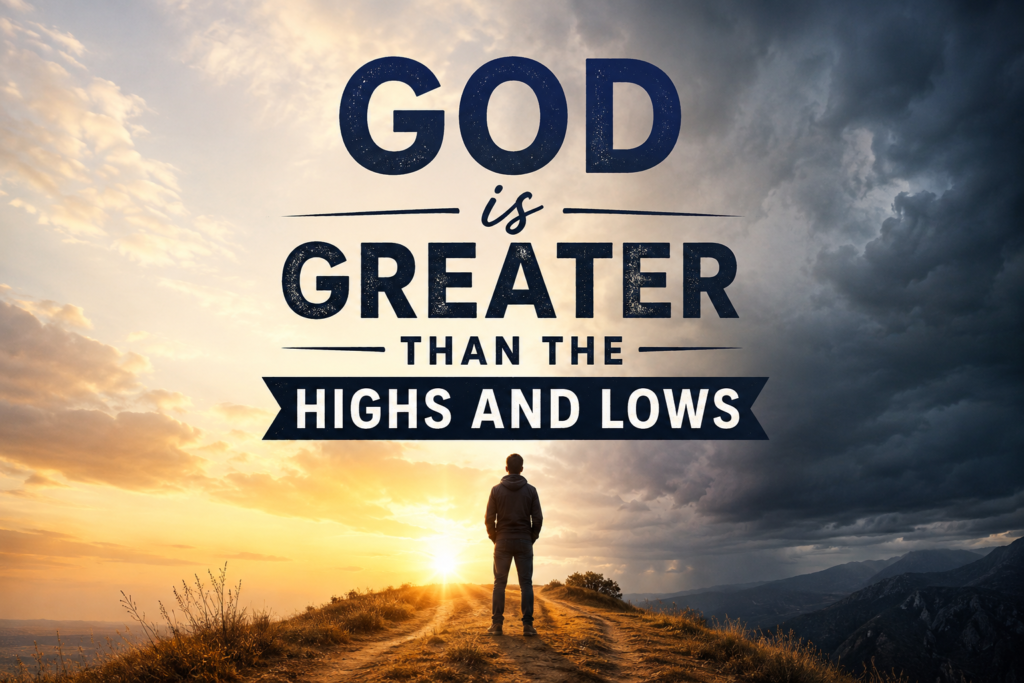
Meta Description: God is greater than the highs and lows of life. Discover how faith, prayer, and hope can help you trust God through every season.
Life has a way of changing without warning. One day, everything seems to fall into place. You feel happy, confident, and hopeful. Then, a difficult phone call, a broken relationship, financial stress, or an unexpected loss can turn everything upside down.
These changing seasons can make us wonder where God is. When life feels good, faith may come easily. When life hurts, trusting God can feel much harder.
Yet one powerful truth remains: God is greater than the highs and lows.
Your circumstances change. Your emotions change. Your plans change. God does not. His love, presence, and faithfulness are not based on whether life is going well or falling apart.
This truth can give you a steady foundation when everything around you feels uncertain.
What Does “God Is Greater Than the Highs and Lows” Mean?
The phrase “God is greater than the highs and lows” means that God is bigger than every situation we experience. He is greater than our success, stronger than our failures, and present in both joyful and painful seasons.
The “highs” of life can include answered prayers, career success, family celebrations, financial stability, good health, and personal achievements. These moments are worth enjoying and thanking God for.
The “lows” can include grief, disappointment, loneliness, fear, rejection, illness, financial hardship, and seasons when prayers seem unanswered.
Neither extreme defines God.
When you are at your highest point, you still need God. When you are at your lowest point, God has not left you.
Psalm 46:1 describes God as “our refuge and strength, an ever-present help in trouble.” This reminds us that God’s presence is not limited to peaceful moments. He is also present in trouble.
God Does Not Change When Life Changes
One of the hardest parts of life is accepting how quickly things can change. A job can disappear. A friendship can end. A dream can take longer than expected. A season of comfort can suddenly become a season of uncertainty.
It is easy to connect our view of God with our circumstances.
When things go well, we may think, “God is good because my life is good.”
When things go wrong, we may wonder, “Why would God allow this if He is good?”
But God’s character is not measured by today’s circumstances.
The Bible repeatedly presents God as faithful and unchanging. James 1:17 describes Him as the One “who does not change like shifting shadows.”
That matters because emotions can be unstable. You may wake up hopeful one morning and discouraged the next. You may feel strong today and overwhelmed tomorrow.
God remains the same through both.
Your feelings are real, but they do not have to determine your view of God.
God Is With You in the Highs
We often remember God during difficult times, but joyful seasons need faith too.
Success can make us feel independent. When everything is working, we may stop praying, become less grateful, or begin to believe that we control our own future.
That is why the highs of life are an invitation to practice gratitude.
If you receive a new opportunity, thank God. If your family is doing well, thank Him. If a long-awaited prayer is answered, celebrate it. If you reach a goal you worked hard for, recognize the effort while remembering the people, opportunities, and abilities that helped you get there.
Gratitude keeps success from becoming pride.
Consider someone who finally gets the promotion they have wanted for years. They may feel excited and proud. There is nothing wrong with celebrating that moment. But instead of allowing success to become their identity, they can see it as one part of a larger journey.
The promotion may change their position, but it does not change their worth.
God is greater than the achievement.
God Is With You in the Lows
The lows of life can challenge faith in a deeper way.
When you lose something important, simple answers may not feel helpful. Telling someone to “stay positive” does not remove grief. Saying “everything happens for a reason” may not answer the questions in their heart.
Faith does not mean pretending that pain does not exist.
The Bible contains many honest expressions of fear, sadness, confusion, and grief. The Psalms, for example, often show people crying out to God in difficult circumstances.
This gives us permission to be honest with God.
You can tell God that you are scared. You can admit that you are disappointed. You can ask questions. You can pray when you do not know what to say.
A low season does not mean you have failed spiritually.
Sometimes faith looks less like confidence and more like holding on.
When you cannot understand what God is doing, you can still choose to trust who God is.
Your Highs and Lows Do Not Define You
One reason life’s ups and downs affect us so deeply is that we often connect circumstances with identity.
If we succeed, we think we are valuable.
If we fail, we think we are worthless.
If people accept us, we feel secure.
If someone rejects us, we question ourselves.
But your identity is deeper than your circumstances.
You are not your job. You are not your bank account. You are not your relationship status. You are not your mistakes. You are not your achievements.
For a person of faith, identity begins with being loved and known by God.
This truth can create emotional stability. Success becomes something to celebrate rather than something you must use to prove your worth. Failure becomes something you can learn from rather than a final judgment on your life.
God is greater than your best day, and He is greater than your worst day.
What to Do When You Are Going Through a Low Season
When life feels heavy, start with small steps.
Pray honestly, even if your prayer is only a few words. You do not need perfect language to approach God. A simple prayer such as “God, I need You today” can be a meaningful expression of faith.
Spend time with Scripture. During difficult seasons, familiar verses can remind you of truths that emotions may cause you to forget. Philippians 4:6–7 encourages believers to bring their worries to God through prayer.
Stay connected to people you trust. Faith is not meant to be lived in isolation. A caring friend, family member, pastor, mentor, or church community can offer encouragement when your own strength feels limited.
Take care of your daily needs too. Rest, healthy routines, meaningful conversations, and time away from constant stress can help you process difficult circumstances. Trusting God does not mean ignoring practical steps.
Most importantly, do not assume that a painful season will last forever.
A season is not the whole story.
Real Faith Is Not the Absence of Struggle
It is easy to look at another person’s life and assume they have stronger faith because they appear happy and confident.
Social media can make this even worse. We often see celebrations, vacations, promotions, weddings, and achievements. We rarely see the private struggles behind those moments.
Real faith does not mean having a perfect life.
Real faith means continuing to turn toward God when life is imperfect.
A person can cry and still have faith. They can feel afraid and still trust God. They can have unanswered questions and still pray. They can experience disappointment and still believe that God is present.
Faith is not always loud.
Sometimes faith is simply getting out of bed, praying one more time, and choosing not to give up.
How to Keep God at the Center of Every Season
The best time to build a strong relationship with God is not only when you are in trouble. Develop spiritual habits during ordinary days so they can support you during difficult ones.
Make prayer part of your normal routine. Read Scripture regularly. Practice gratitude when life is going well. Serve others. Stay connected to a healthy faith community. Take time to reflect on how God has carried you through previous challenges.
Remembering the past can strengthen you in the present.
Think about a difficult season you once believed you would never survive. You survived it. Perhaps the situation changed, or perhaps you changed while walking through it. Either way, you can look back and recognize moments of grace, strength, support, or unexpected provision.
Those memories can become reminders that today’s struggle is not the end of your story.
God Is Greater Than Your Fear of the Future
Many highs and lows are connected to uncertainty about what comes next.
We worry about tomorrow because we cannot control it.
Will I get the job? Will this relationship work? Will my family be okay? Will I recover from this setback? Will my plans succeed?
These questions can consume our thoughts.
Jesus addresses this kind of anxiety in Matthew 6 by encouraging His followers not to live consumed by worry about tomorrow. The point is not that tomorrow will never contain difficulties. The point is that we do not have to carry tomorrow’s burdens today.
You can make wise plans while still trusting God.
You can work hard without believing everything depends on you.
You can hope for a good outcome while accepting that you cannot control every detail.
That is where faith creates freedom.
The Highs and Lows Can Both Grow Your Faith
We usually want the highs and want to escape the lows. But both can teach us something.
High seasons can teach gratitude, humility, generosity, and stewardship.
Low seasons can teach patience, dependence, compassion, perseverance, and deeper trust.
Romans 5:3–4 connects suffering with perseverance, character, and hope. This does not mean that suffering is good in itself. It means God can work through painful experiences and bring growth from them.
A difficult chapter can become part of a stronger story.
The person who has experienced loss may become more compassionate toward others. Someone who has struggled financially may learn greater contentment. Someone who has faced failure may discover that their worth was never dependent on success.
God can bring meaning, growth, and hope even when we cannot see the full picture yet.
Frequently Asked Questions About God Being Greater Than the Highs and Lows
What does “God is greater than the highs and lows” mean?
It means God is greater than every circumstance, emotion, success, failure, blessing, and hardship we experience. Life changes, but God’s character and presence remain constant.
What Bible verse says God is greater than our circumstances?
Several Bible passages point to this truth. Psalm 46:1 describes God as a refuge and strength in trouble, while Romans 8:38–39 teaches that nothing can separate believers from the love of God.
How do I trust God when life is difficult?
Start by being honest with God in prayer. Read Scripture, stay connected to supportive people, and focus on what you can do today rather than trying to solve your entire future at once. Trust often grows through small, repeated choices.
Does having struggles mean my faith is weak?
No. Struggle does not automatically mean weak faith. Many biblical figures experienced fear, grief, doubt, and hardship. Faith can exist alongside difficult emotions and unanswered questions.
How can I keep faith when my prayers seem unanswered?
Continue praying while giving yourself permission to acknowledge your disappointment. Seek wise support and focus on God’s character rather than trying to predict exactly how or when He will answer. An unanswered prayer can be painful, but it does not mean God has forgotten you.
Why should I trust God during good times?
Good seasons can create a false sense of independence. Trusting God during success helps you remain grateful, humble, and grounded. The goal is not to seek God only when life hurts but to walk with Him through every season.
Conclusion: God Is Greater Than Every Season
Life will have highs and lows. There will be days when you feel strong and days when you feel like you have nothing left. There will be answered prayers and seasons of waiting. There will be celebrations, disappointments, beginnings, endings, victories, and setbacks.
But none of them are greater than God.
Your best season does not make God more faithful. Your hardest season does not make Him less faithful.
When life is good, thank Him.
When life is painful, seek Him.
When the future is unclear, trust Him one day at a time.
And when you cannot see how everything will work out, remember this: God is greater than the highs and lows.
Do not let a temporary circumstance become a permanent definition of your life. Keep praying. Keep trusting. Keep moving forward. Look for God’s presence in the ordinary moments, lean on Him in the difficult ones, and remain grateful in the joyful ones.
Whatever season you are in today, you do not have to face it alone. Choose faith over fear, hope over despair, and trust over the need to control everything. Keep God at the center, and let His unchanging presence become your steady ground.