



The term quartist is gaining interest across different discussions, yet many people still ask what it means and why it matters. Depending on context, quartist can relate to creative identity, structured thinking, innovation models, or a niche conceptual framework used in modern analysis and artistic interpretation.
What makes quartist interesting is its flexibility. It can describe a mindset, a method, or even a philosophy built around balance, four-part systems, and organized creativity. As industries move toward interdisciplinary approaches, concepts like quartist are becoming more valuable.
In this guide, you will learn what quartist means, where it applies, how it works, and why it continues to attract attention.
What Is Quartist?
At its core, quartist refers to a concept centered on the power of four-part structures. The root of the term often connects to “quart,” suggesting four elements working together as a unified system.
A quartist approach often emphasizes:
- Balance among multiple components
- Structured creativity
- Harmony through organization
- Problem-solving using interconnected parts
Unlike rigid models that focus on single-track solutions, quartist thinking often encourages seeing relationships among four dimensions at once.
For example, a project manager may apply quartist thinking by balancing strategy, execution, communication, and measurement rather than focusing only on deadlines.
This makes quartist more than a word. It becomes a practical framework.
The Origin and Meaning Behind Quartist
While quartist may appear modern, the idea behind it reflects older patterns found in philosophy, mathematics, design, and even nature.
Many systems rely on groups of four:
The four seasons create natural cycles.
Four cardinal directions shape navigation.
Four foundational elements appear in historical philosophy.
Four-part harmonies define many artistic traditions.
Quartist takes inspiration from these patterns and applies them in a contemporary way.
This is why some people associate quartist with creativity, while others see it as a strategic method.
Both interpretations can be valid.
How Quartist Works
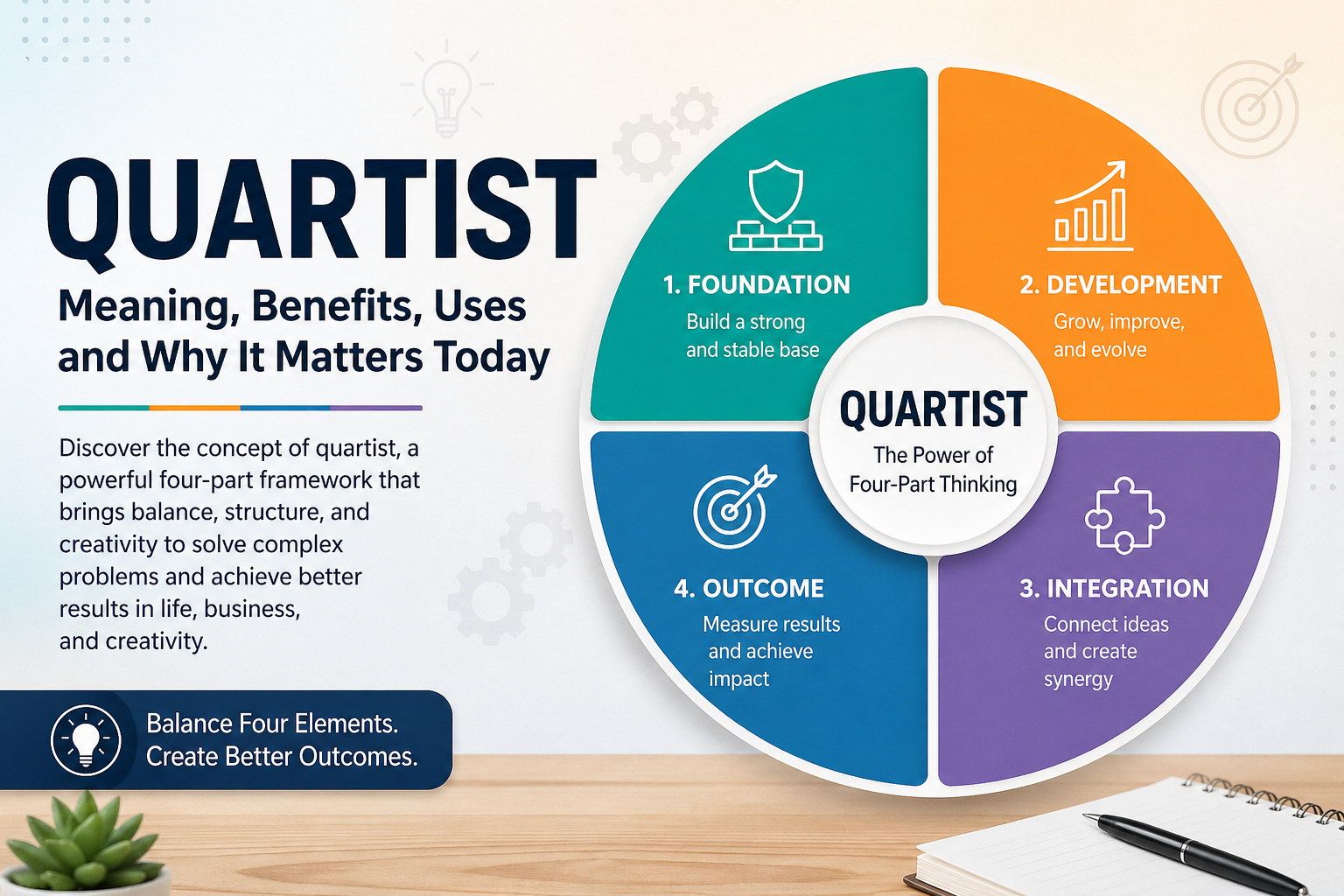
The quartist concept often functions through four connected pillars. While models vary, a common structure includes:
1. Foundation
Every quartist framework begins with a stable base. This is the structure supporting the whole system.
For a business, this may be resources.
For an artist, it may be technique.
For an individual, it may be values.
Without a foundation, the remaining parts struggle.
2. Development
The second element focuses on growth and movement.
This is where ideas evolve.
Processes improve.
Skills strengthen.
A quartist model does not stay static. It develops.
3. Integration
This is where parts connect.
Ideas stop operating in isolation.
Systems begin working together.
This often becomes the most valuable stage because disconnected pieces become a functional whole.
4. Outcome
The final dimension measures results.
Did the model create efficiency?
Did it improve creativity?
Did it solve a problem?
Without outcome evaluation, the system remains incomplete.
These four dimensions often explain how quartist methods operate in practical settings.
Why Quartist Is Becoming Popular
Interest in quartist has grown because people increasingly seek flexible frameworks rather than rigid formulas.
Traditional approaches often focus on linear solutions.
Problem.
Solution.
Outcome.
But modern challenges rarely work that way.
A business decision may involve marketing, finance, technology, and user behavior at once.
A creative project may combine design, storytelling, research, and audience engagement.
Quartist supports this complexity.
That is one reason it is gaining traction.
Quartist in Creative Fields
Creative professionals often use quartist principles without realizing it.
A designer may balance:
Concept
Color
Composition
Audience impact
That is a four-part structure.
A writer may build around:
Theme
Character
Conflict
Resolution
Again, quartist logic appears.
This framework helps creators avoid imbalance.
Too much focus on one element can weaken the whole.
Balanced creative systems often produce stronger outcomes.
Quartist in Business Strategy
Business leaders increasingly use multi-dimensional planning, which aligns closely with quartist ideas.
Consider a company launching a product.
Success may depend on:
Market research
Product quality
Brand positioning
Customer retention
Ignoring one weakens performance.
Strong businesses often operate through balanced systems rather than isolated tactics.
That is essentially quartist thinking.
Real-world data supports this. Research in organizational strategy often shows integrated decision-making improves long-term performance more than silo-based planning.
This is why frameworks like quartist matter.
Quartist in Personal Development
Quartist also applies to self-improvement.
Many growth systems focus only on productivity.
But personal development usually requires balance among several dimensions.
A quartist personal model may include:
Mental growth
Physical well-being
Emotional resilience
Practical achievement
If one area is neglected, progress often feels incomplete.
Someone with career success but no well-being may feel unbalanced.
Someone focused only on health without purpose may feel stalled.
Quartist thinking helps create a fuller approach.
Benefits of Using a Quartist Approach
There are several reasons people adopt quartist frameworks.
Better Balance
Many problems come from overemphasizing one area.
Quartist encourages equilibrium.
That often reduces risk.
Clearer Decisions
Breaking issues into four connected dimensions often makes choices easier.
Complexity becomes manageable.
Stronger Creativity
Structured creativity often outperforms random experimentation.
Quartist can support innovation without chaos.
Improved Systems Thinking
Instead of isolated thinking, quartist builds connections.
This often leads to smarter strategies.
Greater Adaptability
Because the framework is flexible, it can work across industries and goals.
That versatility increases value.
Real-Life Example of Quartist Thinking
Imagine a startup struggling with growth.
Its team initially focuses only on advertising.
Traffic increases, but sales stay weak.
Using a quartist approach, they assess four areas:
Marketing attracts visitors.
Product needs improvement.
Customer support has gaps.
Retention strategy is missing.
By balancing all four, revenue improves.
The issue was never traffic alone.
It was imbalance.
This example shows why quartist can be practical rather than abstract.
Common Misunderstandings About Quartist
Some people assume quartist is overly theoretical.
That is not always true.
Others think it applies only to art.
Again, not accurate.
Another misconception is that quartist always means exactly four steps.
In reality, it often centers more on four interconnected dimensions than rigid rules.
It is a framework, not a formula.
That distinction matters.
How to Apply Quartist in Daily Life
You do not need formal training to use quartist thinking.
Start by identifying four factors affecting a challenge.
Suppose you want to improve productivity.
Instead of only working harder, assess:
Time management
Focus
Energy
Systems
Then strengthen weak areas.
This creates balanced improvement.
The same process can apply to business decisions, creative work, and personal goals.
Simple use often produces meaningful results.
Quartist and Innovation
Innovation rarely comes from isolated thinking.
Breakthroughs often happen when multiple dimensions interact.
That fits quartist principles.
A product innovation may require:
Technology
User insight
Design
Execution
Without all four, innovation may fail.
This is why quartist often aligns with modern innovation methods.
It encourages interconnected thinking.
Is Quartist a Trend or a Lasting Framework?
Some emerging concepts fade quickly.
Others grow because they solve real problems.
Quartist appears to have lasting potential because it reflects patterns already present in successful systems.
Balance.
Integration.
Multi-dimensional thinking.
These are not temporary needs.
They are ongoing realities.
That gives quartist staying power.
Challenges of Using Quartist
No framework is perfect.
Quartist can face challenges.
One challenge is overcomplication.
Some users may force every issue into a four-part model.
That can become artificial.
Another challenge is weak execution.
Simply identifying four factors does not guarantee success.
Application matters.
The framework works when paired with critical thinking.
Used well, it adds clarity.
Used poorly, it can become vague.
Future Potential of Quartist
As interdisciplinary work expands, quartist may become more relevant.
Fields increasingly overlap.
Business meets technology.
Creativity meets data.
Strategy meets psychology.
Frameworks that support connected thinking are likely to grow.
Quartist fits this direction.
That makes it worth watching.
Should You Use a Quartist Framework?
If you deal with complexity, creative challenges, planning, or decision-making, quartist may offer value.
It can help when:
You feel stuck in one-dimensional thinking.
A project lacks balance.
A system feels fragmented.
A problem involves multiple variables.
It is especially useful when simple solutions fail.
That is often where frameworks become valuable.
Practical Tips for Getting Started With Quartist
If you want to experiment with quartist, begin small.
Take one challenge.
Break it into four key dimensions.
Study how those parts interact.
Adjust weak points.
Measure results.
Refine the model.
That process often reveals insights you may miss otherwise.
Start simple.
Scale later.
That approach works best.
Conclusion
Quartist is more than an emerging term.
It represents a practical way to think through balance, structure, creativity, and interconnected systems.
Whether applied in business, personal growth, innovation, or creative work, quartist offers a useful framework for navigating complexity.
Its strength lies in seeing relationships, not isolated parts.
That perspective often leads to stronger decisions and better outcomes.
If you want a smarter way to approach challenges, consider applying quartist thinking to your next project and test how a balanced four-part framework can improve results.
Frequently Asked Questions
What does quartist mean?
Quartist generally refers to a concept or framework built around four interconnected dimensions, often emphasizing balance, structure, and integrated thinking.
Is quartist related to art?
It can be. Some use quartist in creative contexts, but it can also apply to strategy, business, innovation, and personal development.
How does quartist work?
It often works by organizing a problem or system into four connected components, then improving balance among them.
Is quartist a methodology?
In many cases, yes. It can function as a flexible methodology for structured analysis and problem-solving.
Why is quartist becoming popular?
Interest is growing because modern challenges often require multidimensional thinking, and quartist supports that need.
Can beginners use quartist?
Yes. Anyone can apply quartist by identifying four important factors in a challenge and evaluating how they interact.
Is quartist useful in business?
Yes. It can support planning, innovation, risk management, and integrated decision-making.
How do I start using quartist?
Start with one problem, divide it into four dimensions, assess balance among them, and improve weak areas. That is often the simplest entry point.

